


Blog
What Actually Happens When You Calibrate an ECU on Heavy-Duty Equipment

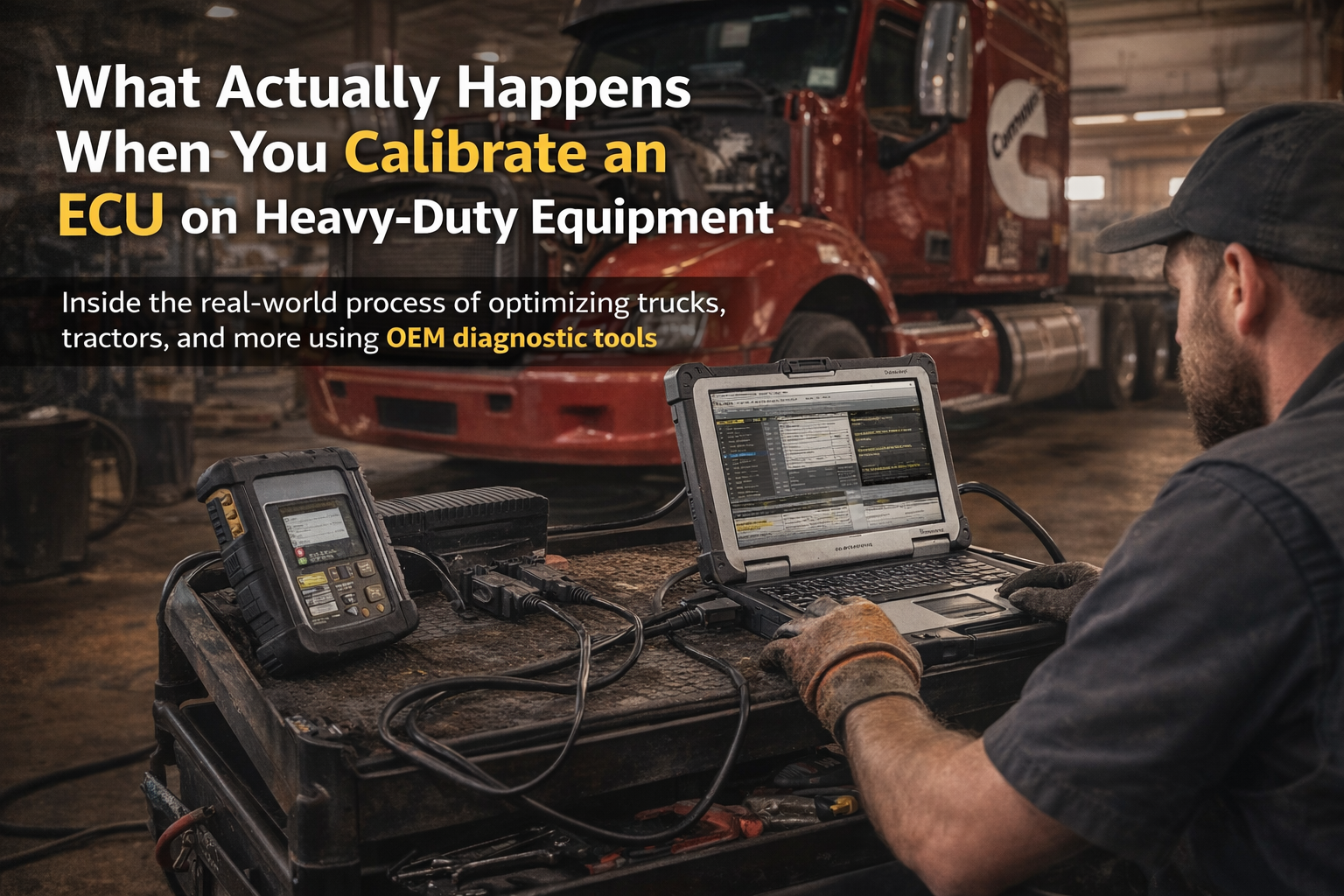
ECU calibration tools are essential for modern heavy-duty equipment diagnostics and performance optimization.
Most people think ECU calibration is about getting more power.
That is not what is really happening.
In heavy-duty equipment, whether it is a truck pulling weight across long distances or a machine working full days on-site,
the ECU is not just controlling the engine. It is constantly balancing fuel delivery, temperature, pressure, emissions systems, and load conditions. It makes decisions every second.
Calibration is the point where you step into that system and adjust how the machine responds.
Not randomly, but based on real data.
That is where the difference between basic tools and OEM-level systems becomes clear.
It starts with visibility
Before anything is adjusted, you need to understand what the machine is actually doing.
With proper OEM diagnostic software, you are not guessing. You are reading:
- live engine load
- fuel delivery behavior
- sensor response
- aftertreatment activity
You begin to notice patterns that are not visible during normal operation.
For example, a truck that feels weak under load may not have a mechanical issue. It can be limited by calibration rules reacting to temperature or emissions conditions.
Without the right tools, this stays hidden.
👉 Access full diagnostic platforms:
https://the-best-manuals-online.com/product-category/diagnostic-software/
Calibration is not one-size-fits-all
There is no single calibration that works for every machine.
A tractor working soft soil behaves differently from one operating in dry conditions.
A long-haul truck is not the same as a vehicle working short heavy cycles.
OEM systems allow adjustments that match real working conditions.
You are not changing the engine itself. You are adjusting how it reacts in its environment.
Hardware plays a critical role
Even the best software depends on stable communication.
Professional setups rely on dedicated interface hardware, not generic cables. These tools ensure reliable communication with control units during reading and writing processes.
Unstable connections can lead to incomplete programming or system errors.
👉 See compatible diagnostic interfaces:
https://the-best-manuals-online.com/product-category/diagnostic-interface-cables/
Where calibration makes a real difference
Not in marketing numbers, but in daily work.
- smoother throttle response under load
- fewer unnecessary regeneration cycles
- more consistent engine behavior
- better response to changing conditions
These are the improvements operators actually notice.
Over time, this leads to:
- reduced downtime
- more predictable performance
- easier maintenance and troubleshooting
The shift in workshop approach
Workshops no longer separate diagnostics from performance work.
Today, calibration is part of the diagnostic process.
Instead of fixing an issue and stopping there, technicians adjust the system so the same problem does not return under similar conditions.
This requires tools that can both analyze and apply changes accurately.
👉 Explore complete diagnostic setups:
https://the-best-manuals-online.com/product-category/laptop-kit/
Access to calibration files and flash solutions
In many cases, ECU calibration work involves working with prepared data files rather than building adjustments from scratch.
Professional environments often rely on structured calibration files and flash solutions that are designed for specific engine platforms and control units. These files allow technicians to apply consistent configurations while maintaining control over system behavior.
Instead of manual trial and error, access to ready-to-use calibration data simplifies the workflow and reduces the time required for programming.
👉 Explore available calibration and flash file solutions:
https://the-best-manuals-online.com/product-category/dpf-egr-scr-bac-erg-delete/
The bigger picture
Modern engines are no longer mechanical systems supported by electronics.
They are electronic systems that control mechanical output.
Calibration is not about pushing limits. It is about understanding how the system works and improving how it behaves under real conditions.
Without OEM-level access, you are only seeing part of the picture.
Discover more from The Best Manuals Online
Subscribe to get the latest posts sent to your email.


